CloudInsidr

Cyber security, infotech

  • Subscribe!
  • Privacy Policy
  • Legal
  • Contact Us

Join us on Twitter: @CloudInsidr

Follow us on Twitter: @cloudinsidr
  • news & alerts
    • events
    • industry analysis
    • industry gossip
    • people
  • cloud, edge & co.
    • AWS
    • administration & orchestration
      • web servers in the cloud
      • mail servers
      • databases
  • cybersec & warfare
    • encryption
  • blockchain
Home cybersecurity and cyber warfare TLS tune-up: how to restrict Firefox to TLS v1.3 and v1.2 to protect from phishing attacks
TLS tune-up: how to restrict Firefox to TLS v1.3 and v1.2 to protect from phishing attacks

Cloud Insidr 2018-06-02 Leave a Comment

TLS tune-up: how to restrict Firefox to TLS v1.3 and v1.2 to protect from phishing attacks

Only two versions of the TLS (Transport Layer Security) protocol can be considered safe under certain circumstances: TLS 1.3 and TLS 1.2. Trying to get your bank alongside everyone else to fix their websites and web applications is a Herculean task; good luck trying. Even so, you can protect TLS connections by modifying the browser configuration.

It is good to know that there is something you can do to protect at least yourself and the other end users on the networks that you oversee from nasty attacks against their TLS connections. In Firefox, you can restrict the browser to “speak” only TLS 1.3 and TLS 1.2 to limit the attack surface and restrict phishing. Here is how to do it.

Here is a short how-to on restricting Firefox to the two most secure versions of the TLS protocol:

Step 1. Open the advanced settings page of Firefox.

In the address bar, enter

about:config

and hit Return.

Step 2. Agree to “void your warranty”.

Ignore the warning about voiding your warranty and proceed.

Step 3. Find the security settings for TLS

In the Search bar, type in “security.tls”.

Step 4. Adjust the lowest version of the TLS protocol you want to allow

Double click the entry “security.tls.version.min”. The default value is 1. Change it from “1” to “3”. This will activate TLS 1.2 and disallow any version below. This change is important as it prevents protocol downgrade attacks irrespective of the actual server settings. Eliminating the possibility of a protocol downgrade allows you to protect TLS connections from some attempts at eavesdropping.

Step 5. Adjust the highest version of the TLS protocol you want to allow

Verify that “security.tls.version.max” is set to to “4”. This ensures that Firefox may use TLS 1.3, (but not above; should TLS reach a higher version number, you will need to revisit this setting).
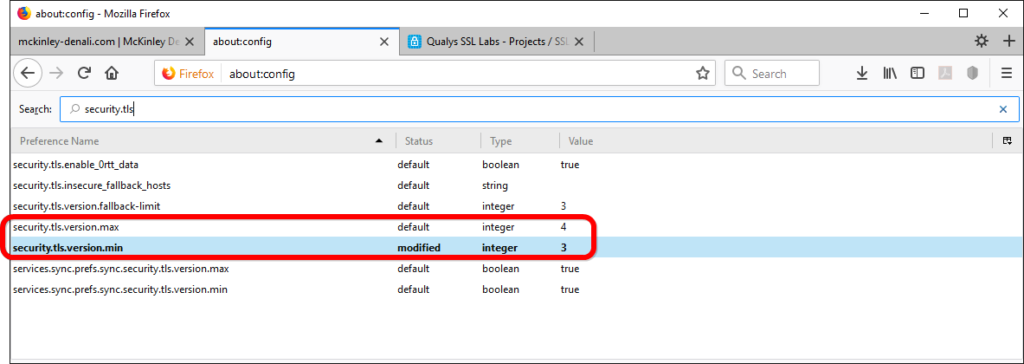
Restricting Firefox to TLS version 1.3 and TLS 1.2

Now, your Firefox web browser speaks only TLS 1.3 and TLS 1.2; you will not be able to connect to websites that do not support these two protocols, but then again—perhaps you shouldn’t. Either way, there aren’t that many of them left.

Step 6. Test your configuration

Head over to Qualys SSL Labs’ browser test:

https://www.ssllabs.com/ssltest/viewMyClient.html

Step 7. Verify the test results

Allow the test to run its course. In the overview of details, look for the section “Protocol Features”. In the list of supported protocols, verify that only TLS 1.3 and TLS 1.2 are allowed.
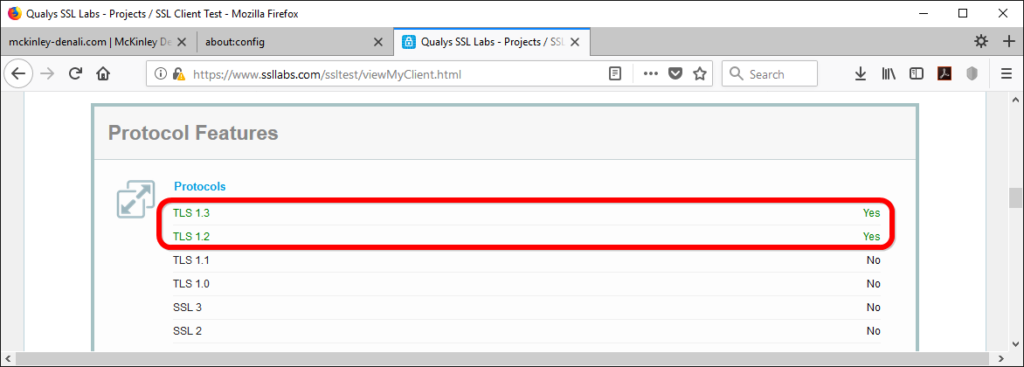
Restricting Firefox to TLS version 1.3 and TLS 1.2 makes browsing safer
Browser test by Qualys SSL Labs reveals that the attempt at restricting Firefox to TLS 1.3 and 1.2 was successful

These changes do not offer absolute security as such a thing doesn’t even exist. They offer protection in so far as they limit the attack surface without compromising compatibility.

It goes without saying that if you happen to oversee the configuration of a web host, you need to take some steps to ensure that it measures up to the demands you put on your own Firefox for the sake of your visitor’s safety (see “How to Activate HTTP/2 with TLS 1.3 Encryption in NGINX for Secure Connections without a Performance Penalty” and “TLS 1.3 (with AEAD) and TLS 1.2 cipher suites demystified: how to pick your ciphers wisely” for more).


Filed Under: cybersecurity and cyber warfare, encryption Tagged With: TLS, TLS 1.2, TLS 1.3, TLS vulnerabilities

Leave a Reply Cancel reply

Your email address will not be published. Required fields are marked *

Subscribe

SSL/TLS Certificate Square (250 x 250)

Pearson Education (InformIT)

SSL/TLS Certificate Medium Rectangle (300 x 250)

Recent Posts

  • Upgrading from CentOS 6 to CentOS 7 and Beyond?
  • How To Figure Out Who is Signing In To Dovecot to Send or Retrieve Email
  • OpenSSH 9.9 Introduces Enhanced Quantum-Resistant Algorithms
  • OpenSSL 3.3 Final Release is now live!
  • How to Activate HTTP/2 with TLS 1.3 Encryption in NGINX for Secure Connections without a Performance Penalty
  • Is AWS sucking your budget dry? Strip it down to the nitty-gritty (without breaking stuff)
  • How to attach and mount an NVMe EBS volume on EC2
  • SELinux security contexts: correcting SELinux labels on a file system
  • Intel gobbling up Israeli Tower Semiconductor, Stock Goes Through The Roof
  • NGINX on AWS EC2: setting up a web server from scratch on a domain of your choice
  • Log4j RCE and mitigation techniques
  • Set up logrotate for Postfix

Symantec

Categories

  • administration and orchestration
  • alerts
  • AWS
  • Bitcoin
  • cloud, edge and everything in between
  • cryptocurrencies
  • cybersecurity and cyber warfare
  • databases
  • DNS
  • encryption
  • events
  • FinTech and InsurTech
  • homeland security
  • HTTP Security Headers
  • industries
  • industry analysis
  • industry gossip
  • Java
  • Linux
  • mail servers
  • networking
  • news
  • NGINX
  • people
  • php-fpm
  • reviews
  • SELinux
  • tips and tricks
  • Uncategorized
  • web servers in the cloud

Tags

AMI AWS AWS EBS Azure certificate cipher suites cryptography cyber defense cybersecurity cyber security Diffie-Hellman DNS DNS over HTTPS Dovecot EBS EC2 email encryption Fedora HTTP/2 HTTPS IBM letsencrypt Linux logs MariaDB MFA MySQL NGINX OpenSSL permissions php-fpm PHP 7 postfix RegEx Route 53 RSA SELinux SQL SSH SSL TLS TLS 1.3 TLS vulnerabilities WordPress

Archives

  • January 2025
  • November 2024
  • October 2024
  • May 2024
  • January 2023
  • March 2022
  • February 2022
  • December 2021
  • December 2020
  • November 2020
  • September 2020
  • January 2020
  • November 2019
  • August 2019
  • July 2019
  • April 2019
  • December 2018
  • October 2018
  • September 2018
  • August 2018
  • June 2018
  • May 2018
  • April 2018
  • February 2018
  • December 2017
  • November 2017
  • October 2017
  • August 2017
  • April 2017
  • February 2017
  • January 2017
  • November 2016
  • September 2016
  • August 2016
  • July 2016
  • March 2016
  • February 2016
  • January 2016
  • December 2015
  • November 2015
  • October 2015
  • September 2015
  • July 2015
  • February 2015

Recent Comments

    Wicked fast Networking (With a Government Clearance to Boot)

    ©2022 CybrAnalytiqa OÜ

    • Content purchasing and syndication