
CloudInsidr

Cyber security, infotech

  • Subscribe!
  • Privacy Policy
  • Legal
  • Contact Us

Join us on Twitter: @CloudInsidr

Follow us on Twitter: @cloudinsidr
  • news & alerts
    • events
    • industry analysis
    • industry gossip
    • people
  • cloud, edge & co.
    • AWS
    • administration & orchestration
      • web servers in the cloud
      • mail servers
      • databases
  • cybersec & warfare
    • encryption
  • blockchain
Home cybersecurity and cyber warfare OpenSSH 9.9 Introduces Enhanced Quantum-Resistant Algorithms
OpenSSH 9.9 Introduces Enhanced Quantum-Resistant Algorithms

Cloud Insidr 2024-10-04 Leave a Comment

OpenSSH 9.9 Introduces Enhanced Quantum-Resistant Algorithms

OpenSSH 9.9 is now available for download on the official mirrors of the OpenBSD Project. This update introduces a range of significant enhancements, such as the support for post-quantum key exchange, improved security controls, and various performance enhancements.

Key Features in OpenSSH 9.9

One of the most notable advancements in OpenSSH 9.9 is the introduction of a hybrid post-quantum key exchange method. It combines the FIPS 203 Module-Lattice Key Encapsulation Mechanism (ML-KEM) with X25519 Elliptic Curve Diffie-Hellman (ECDH). This hybridization is believed to boost security against future quantum computing threats. The algorithm, known as mlkem768x25519-sha256, is enabled by default.

Post-quantum cryptographic standards could be around the corner.

In addition, the ssh_config “Include” directive now supports environment variable expansion and the use of the same set of %-tokens as the “Match Exec” option. This enhancement provides more flexibility in dynamic configuration file management.

OpenSSH 9.9 also brings the “RefuseConnection” option in sshd_config. It allows administrators to swiftly drop unwanted connections at the first authentication attempt. A new “refuseconnection” penalty class in the sshd_config “PerSourcePenalties” enables automated penalties for connections dropped using this keyword.

Further enhancing authentication controls, the sshd_config “Match” options now include a “Match invalid-user” predicate. This enables administrators to identify and manage attempts from usernames that do not exist on the server, offering more granular control over access attempts.

The update also improves performance with a streamlined implementation of the NTRUPrime key exchange code, resulting in faster execution and better overall efficiency.

OpenSSH 9.9 is a robust, secure, and forward-thinking piece of technology. The neweest release aligns with the latest cryptographic standards and addresses emerging security needs quite reliably.
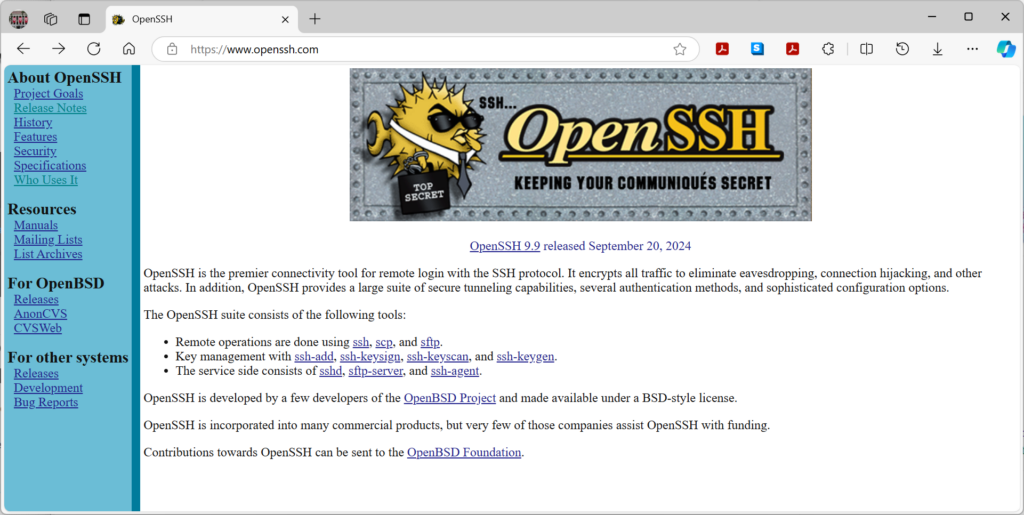
OpenSSH 9.9
OpenSSH 9.9

Bug Fixes in OpenSSH 9.9

OpenSSH 9.9 addresses a number of important bugs, further improving the reliability and performance of the software:

  • Key Type Name Parsing: Implements stricter rules for parsing key type names, limiting user-interface code to short names while enforcing the use of full SSH protocol names in other contexts.
  • Relaxed Absolute Path Requirement: Restores the previous behavior, allowing sshd to start without the requirement of an absolute path when operating in inetd mode.
  • Logging Fixes: Resolves an issue where sshd log messages had swapped source and destination addresses.
  • Authorized Keys Handling: Corrects a bug where authorized_keys options were incorrectly applied when signature verification failed.
  • User@Host Parsing: Ensures consistent parsing of strings containing the “@” symbol by looking for the last occurrence, allowing for usernames that include “@” characters.

Deprecation Notice

It’s important to note that OpenSSH plans to phase out support for the DSA signature algorithm by early 2025. In the 9.9 release, DSA is disabled by default during compile time.

DSA, as defined in the SSHv2 protocol, is considered insecure. Its use of 160-bit private keys and the SHA1 digest provides only an estimated 80-bit symmetric security equivalent. In other words: not good enough.

Since 2015, OpenSSH has discouraged the use of DSA keys, maintaining only optional runtime support. With more robust algorithms now widely available across all actively maintained SSH implementations, the decision to deprecate DSA reflects the diminishing value of supporting this weaker encryption standard.

Filed Under: administration and orchestration, cybersecurity and cyber warfare, news Tagged With: cryptography, OpenSSH

Leave a Reply Cancel reply

Your email address will not be published. Required fields are marked *

Subscribe

SSL/TLS Certificate Square (250 x 250)

Pearson Education (InformIT)

SSL/TLS Certificate Medium Rectangle (300 x 250)

Recent Posts

  • Upgrading from CentOS 6 to CentOS 7 and Beyond?
  • How To Figure Out Who is Signing In To Dovecot to Send or Retrieve Email
  • OpenSSH 9.9 Introduces Enhanced Quantum-Resistant Algorithms
  • OpenSSL 3.3 Final Release is now live!
  • How to Activate HTTP/2 with TLS 1.3 Encryption in NGINX for Secure Connections without a Performance Penalty
  • Is AWS sucking your budget dry? Strip it down to the nitty-gritty (without breaking stuff)
  • How to attach and mount an NVMe EBS volume on EC2
  • SELinux security contexts: correcting SELinux labels on a file system
  • Intel gobbling up Israeli Tower Semiconductor, Stock Goes Through The Roof
  • NGINX on AWS EC2: setting up a web server from scratch on a domain of your choice
  • Log4j RCE and mitigation techniques
  • Set up logrotate for Postfix

Symantec

Categories

  • administration and orchestration
  • alerts
  • AWS
  • Bitcoin
  • cloud, edge and everything in between
  • cryptocurrencies
  • cybersecurity and cyber warfare
  • databases
  • DNS
  • encryption
  • events
  • FinTech and InsurTech
  • homeland security
  • HTTP Security Headers
  • industries
  • industry analysis
  • industry gossip
  • Java
  • Linux
  • mail servers
  • networking
  • news
  • NGINX
  • people
  • php-fpm
  • reviews
  • SELinux
  • tips and tricks
  • Uncategorized
  • web servers in the cloud

Tags

AMI AWS AWS EBS Azure certificate cipher suites cryptography cyber defense cybersecurity cyber security Diffie-Hellman DNS DNS over HTTPS Dovecot EBS EC2 email encryption Fedora HTTP/2 HTTPS IBM letsencrypt Linux logs MariaDB MFA MySQL NGINX OpenSSL permissions php-fpm PHP 7 postfix RegEx Route 53 RSA SELinux SQL SSH SSL TLS TLS 1.3 TLS vulnerabilities WordPress

Archives

  • January 2025
  • November 2024
  • October 2024
  • May 2024
  • January 2023
  • March 2022
  • February 2022
  • December 2021
  • December 2020
  • November 2020
  • September 2020
  • January 2020
  • November 2019
  • August 2019
  • July 2019
  • April 2019
  • December 2018
  • October 2018
  • September 2018
  • August 2018
  • June 2018
  • May 2018
  • April 2018
  • February 2018
  • December 2017
  • November 2017
  • October 2017
  • August 2017
  • April 2017
  • February 2017
  • January 2017
  • November 2016
  • September 2016
  • August 2016
  • July 2016
  • March 2016
  • February 2016
  • January 2016
  • December 2015
  • November 2015
  • October 2015
  • September 2015
  • July 2015
  • February 2015

Recent Comments

    Wicked fast Networking (With a Government Clearance to Boot)

    ©2022 CybrAnalytiqa OÜ

    • Content purchasing and syndication